
Anúncios
Detectando Mentiras Através da Voz com Tecnologia

Explore the Technology
The human voice carries far more than just words. Hidden within vocal patterns, pitch variations, and subtle tremors lies a complex web of psychological signals that might reveal when someone isn’t being truthful. As technology advances, apps claiming to identify lies through voice analysis have emerged, promising to turn your smartphone into a portable lie detector.
But can an app really detect when someone is lying just by analyzing their voice? The intersection of artificial intelligence, voice recognition, and psychological research has created a fascinating new field that’s attracting attention from businesses, law enforcement, and curious individuals alike. Let’s explore what these applications can actually do and whether they live up to their bold promises. 🎙️
Anúncios
How Voice-Based Lie Detection Actually Works
Voice analysis technology for detecting deception operates on a fundamental principle: when people lie, their stress levels increase, causing measurable changes in vocal characteristics. These aren’t the obvious signs you might notice in conversation, but micro-variations that require sophisticated algorithms to detect.
The technology examines multiple vocal parameters simultaneously. Pitch fluctuations become more erratic when someone experiences the cognitive load of fabricating information. Speech rate often changes—some people speed up when lying, while others slow down as they carefully construct their false narrative. Micro-tremors in the voice, imperceptible to human ears, can indicate emotional stress associated with deception.
Anúncios
Modern apps use machine learning models trained on thousands of voice samples from controlled studies where participants were instructed to lie or tell the truth. These AI systems identify patterns that correlate with deceptive behavior, creating baseline profiles that can then be applied to new voice recordings.
The Science Behind Vocal Stress Analysis 🔬
Vocal stress analysis (VSA) forms the backbone of most lie detection apps. When we experience stress—including the psychological pressure of lying—our sympathetic nervous system activates. This causes micro-muscle contractions in the larynx that alter voice frequencies in ways humans can’t consciously control or detect without instrumentation.
Research has identified several key vocal markers associated with deception:
- Fundamental frequency changes: The baseline pitch of someone’s voice often rises slightly when lying due to increased tension in vocal cords
- Jitter and shimmer: Irregular variations in pitch and amplitude that increase under stress
- Response latency: The slight delay before answering questions while constructing false narratives
- Speech hesitations: Increased use of filler words like “um,” “uh,” and “you know”
- Energy distribution: Changes in how vocal energy is distributed across different frequency ranges
However, it’s crucial to understand that these indicators suggest stress or cognitive load—not necessarily deception. Someone might display all these vocal markers when discussing a traumatic true experience or when nervously speaking about an uncomfortable topic.
Popular Apps Claiming to Detect Lies Through Voice
The marketplace offers various applications claiming lie detection capabilities, ranging from seemingly serious tools to entertainment-focused novelties. Understanding what’s actually available helps set realistic expectations.
Professional-Grade Voice Analysis Tools 💼
LVA (Layered Voice Analysis) technology represents one of the more established approaches. Originally developed for insurance fraud detection and security screening, LVA-based systems analyze emotional content in speech. Some smartphone apps incorporate simplified versions of this technology, though their accuracy compared to professional systems remains questionable.
VoiceSense applications use proprietary algorithms to assess vocal patterns against psychological states. These apps typically require longer speech samples—often 30 seconds or more—to build a reliable analysis. They’re marketed toward business negotiations, HR screening, and personal relationship management.
Nemesysco-based apps utilize technology from one of the leading companies in voice analysis research. Their consumer applications offer various features including stress detection, excitement measurement, and deception indicators. The company maintains extensive research backing their methodology, though independent verification of their consumer app accuracy is limited.
Entertainment and Novelty Applications 🎮
Many voice lie detection apps make no serious claims about accuracy and position themselves as entertainment. These include “Truth or Lie Detector Simulator,” “Lie Detector Test,” and similar titles that generate results based on randomized algorithms or simple voice characteristic measurements.
While these apps might be fun at parties, they provide no reliable deception detection. Their primary value lies in entertainment rather than any practical application. However, they’ve introduced millions of people to the concept of voice-based lie detection, increasing public awareness of the more serious technology.
Accuracy and Limitations: Separating Fact from Fiction
The critical question everyone asks: do these apps actually work? The answer is complicated and depends heavily on which app, what conditions, and what you mean by “work.” 📊
Scientific studies on voice stress analysis show mixed results. Some research suggests better-than-chance accuracy in controlled settings—typically ranging from 60-70% correct identification of deceptive statements. However, this falls well short of the 90%+ accuracy claimed by some app developers.
Professional polygraph examinations, when administered by trained examiners, achieve approximately 80-90% accuracy according to the American Polygraph Association (though critics dispute these figures). Most smartphone apps cannot replicate the controlled conditions, comprehensive questioning protocols, and expert interpretation that professional examinations employ.
Why Voice Lie Detection Faces Challenges 🚧
Several fundamental obstacles limit the reliability of voice-based lie detection, especially in mobile applications:
Individual variation: People’s baseline vocal characteristics differ dramatically. What constitutes a “stressed” voice pattern for one person might be normal speech for another. Effective lie detection requires establishing an individual baseline—something most apps don’t adequately do.
Environmental factors: Background noise, phone quality, connection issues, and acoustic environments all affect voice recordings. Apps must distinguish between variations caused by deception versus those caused by technical factors.
Countermeasures: Someone aware they’re being analyzed can potentially manipulate results through controlled breathing, rehearsed responses, or emotional detachment techniques. Pathological liars often show reduced stress when lying, making them particularly difficult to detect.
Cultural and linguistic differences: Voice patterns vary across languages and cultures. An algorithm trained primarily on English speakers might perform poorly when analyzing other languages or accented speech.
Context matters: The same vocal stress patterns might indicate deception, nervousness, excitement, or discomfort depending on context that apps cannot fully understand.
Practical Applications and Real-World Use Cases
Despite limitations, voice analysis technology has found legitimate applications in various fields, offering value even when falling short of perfect lie detection. 🌐
Business and Employment Screening
Some companies use voice stress analysis during initial phone screening interviews, looking for indicators of deception regarding qualifications or employment history. While not definitive proof of dishonesty, unusual stress patterns might flag applications for additional scrutiny.
Insurance companies have experimented with voice analysis during claims processing, hoping to identify potentially fraudulent claims early in the investigation process. The technology serves as one data point among many rather than a sole decision-making tool.
Personal Relationships and Communication 💑
Relationship-focused apps market voice analysis as a way to assess honesty during important conversations. While ethically questionable—and potentially harmful to trust—some people use these tools when they suspect infidelity or dishonesty from partners.
Communication coaches sometimes use voice analysis apps to help clients become more aware of how stress affects their speech patterns, improving presentation skills and confidence rather than detecting lies per se.
Security and Law Enforcement Considerations
While inadmissible in most courts, some law enforcement agencies use voice stress analysis as an investigative tool during preliminary interviews. The technology might help investigators decide which leads to pursue more aggressively, though it cannot provide evidence of guilt.
Border security and airport screening operations have tested voice analysis systems for identifying travelers who might warrant additional questioning, though civil liberties concerns have limited widespread adoption.
The Ethics of Voice-Based Lie Detection Technology
The proliferation of lie detection apps raises significant ethical questions that users should carefully consider before deploying such technology. ⚖️
Consent represents the first major concern. Recording and analyzing someone’s voice without their knowledge may violate privacy laws in many jurisdictions. Even when legal, the ethical implications of secretly assessing someone’s truthfulness are troubling.
The potential for false accusations poses serious risks. An app incorrectly flagging truthful statements as lies could damage relationships, careers, or reputations. Given the imperfect accuracy of these technologies, treating app results as definitive truth creates dangerous situations.
Psychological and Social Impact 🧠
Widespread use of lie detection apps could fundamentally alter human interactions. If people believe their voices are constantly being analyzed for deception, conversations might become more guarded and less authentic. The technology could erode rather than enhance trust in relationships and society.
There’s also concern about creating a surveillance mentality where everyone suspects everyone else of lying. Healthy relationships depend on trust as a foundation; technology that encourages constant verification of honesty might undermine that foundation.
The Future of Voice Analysis and Lie Detection
As artificial intelligence and machine learning continue advancing, voice analysis technology will undoubtedly improve. Future developments might address current limitations and expand applications. 🚀
Next-generation systems will likely incorporate multimodal analysis, combining voice patterns with facial micro-expressions, word choice patterns, and contextual understanding. These comprehensive systems might achieve higher accuracy than voice analysis alone.
Personalized AI models that learn individual baseline patterns over time could dramatically improve detection accuracy. Instead of comparing voices against generic databases, these systems would understand your unique vocal characteristics and better identify deviations.
Integration with Communication Platforms
We might see voice analysis features built directly into video conferencing software, phone systems, and messaging platforms. These could provide real-time feedback during conversations, though again raising significant privacy and ethical concerns.
Customer service and support systems may increasingly use voice analysis to assess customer emotions and honesty during interactions, helping companies identify genuinely distressed customers versus those making exaggerated claims.
Making Informed Decisions About Lie Detection Apps
If you’re considering using a voice lie detection app, approach the technology with realistic expectations and ethical awareness. These tools can provide interesting insights but should never be treated as infallible truth detectors. 🎯
For entertainment purposes, these apps offer harmless fun during social gatherings. Just ensure everyone consents to participation and understands results aren’t serious assessments.
For professional applications, consult with legal counsel about privacy laws and admissibility issues. Never make significant decisions—like terminating employees or ending relationships—based solely on app results.
If you’re genuinely concerned about someone’s honesty, direct conversation typically proves more effective than technological analysis. Apps cannot replace human judgment, intuition, and the complex understanding that comes from knowing someone well.
Understanding What Your Voice Reveals Beyond Lies
The most valuable aspect of voice analysis technology might not be lie detection at all, but rather the broader insights it provides about emotional states and communication patterns. 💡
Voice analysis can identify stress, excitement, confidence, hesitation, and numerous other psychological states. This information helps improve communication skills, identify when someone needs support, or recognize your own emotional patterns during different situations.
Public speakers and professionals use voice analysis apps to refine their delivery, ensuring they project confidence and clarity. The feedback helps identify nervous habits like increased pitch or rushed speaking that might undermine their message.
Mental health applications represent another promising direction. Voice pattern changes might indicate developing depression, anxiety, or other conditions, potentially alerting individuals to seek support before problems become severe.
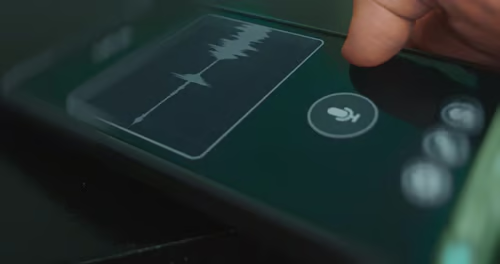
The Bottom Line on Voice Lie Detection Technology
Voice-based lie detection apps represent fascinating technology at the intersection of psychology, artificial intelligence, and communication analysis. They offer tantalizing possibilities for understanding human honesty and deception, but their current capabilities fall short of replacing human judgment or professional investigation techniques.
The science underlying these apps has legitimate foundations—stress genuinely affects vocal characteristics in measurable ways. However, the leap from detecting stress to reliably identifying deception remains problematic. Too many factors influence voice patterns, and individual variation makes universal algorithms difficult to perfect.
For users, these apps work best when viewed as one tool among many rather than definitive truth assessors. They might provide interesting data points or conversation starters, but shouldn’t guide important decisions about trust, honesty, or relationships. The most reliable lie detector remains the combination of human intuition, critical thinking, contextual awareness, and direct communication. 🔍
As technology continues evolving, voice analysis will certainly improve and find valuable applications. But we must balance technological capability with ethical responsibility, ensuring these powerful tools enhance rather than harm human connection and trust.
